Everyone Is Talking About Taste
Now that any idea can be generated with AI, the most important “skill” to have is taste. Or at least this is what some AI experts or tech moguls - founders of Open AI and Y Combinator - have concluded. Not everyone agrees. Here is how the battleground looks: On one side - members of the AI industry stating that taste is now the only core skill that matters. On the other side is Will Mandis, himself a former member of the AI industry, who is arguing that taste is not what led to the great art that so called taste is based on, therefore, it is not an end in and of itself. Mandis blasts the taste argument as a “clean and easy” answer to the question: what are humans for in the world of AI? I initially took what the AI experts said at face value. After all, the logic followed. If we’re no longer involved in the actual making of art, then our role shifts to being solely an evaluator. Being able to do that well - knowing good art when you see it - becomes all the more important. Then the counterargument swayed me against the simplistic reasoning of “taste” and how it reduces an entire realm of subjectivity and critical thinking into a bullet point on a resume. It would seem that things aren’t so clean and easy. But, in that spirit, I offer a different word to move forward with: integrity.
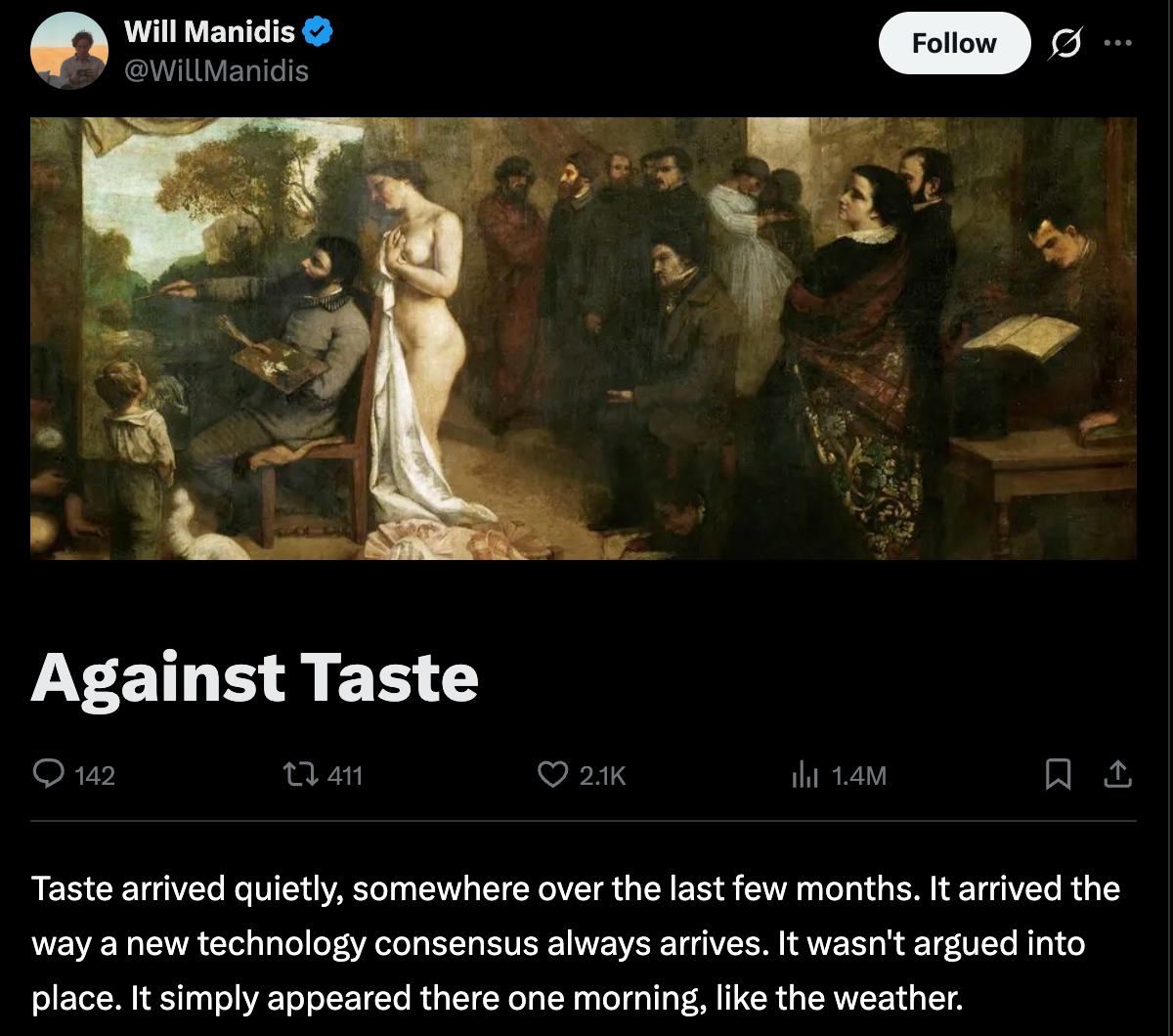
Mandis’s article has 1.4 million views so far
Word choice is important. They carry the weight of historical use, and this is the basis of Mandis’s viral counterargument. “Taste” is young. Art is much, much older. For most of its history, art has been a partnership between labor and patron, and usually aimed at representing something greater than themselves: a god, an ideal, a worldview. The laborers who understood the craft and the patrons funding it didn’t always agree, and this friction, aimed at something transcendent, is what led to great art in the past. Things shifted in modern times. The patron, who was a part of the creative process, was replaced by the collector, who was not, and art became assets - signifiers of wealth and prestige. Artists still strived to depict complex ideas, and continue to do so today, but their names became brands to display with carefully calibrated ostentation. “Taste” was born - and it permeated through art and into fashion, interior design, and so on. It’s less about which art “is” good, and more about which art “makes its owner look good”. We carried that idea of taste as an act of self presentation forward to today. Now, the collector doesn’t need to interact with an artist. They only need to submit a prompt.
If having good taste is the end goal, then you’re working for the approval of others. While it is nice to be validated, the author of the counterargument would say that approach doesn’t move society forward. It’s a backward looking method of discerning quality that leads to circular thinking. Everyone is copying someone else’s style and no one is making anything new. This is, after all, the basic mechanics of generative AI, it just works so fast that its output seems new.
How are we to move forward and make new art, if the old way - patron plus labor partnership - is dead and the new way - generative AI - is here to stay? Taste will remain important, but I think the answer is integrity.
Can an AI generated video of a morbidly obese cat falling through the floor be considered to have any integrity? I would argue that it doesn’t. It’s slop. It looks remarkably real and would have taken a lot of effort to make just a few years ago, but it is slop nonetheless. It doesn’t take a highly developed sense of “taste” to understand that, because that type of content has been around for a while. It’s entertainment created solely to get attention, often made lazily and cheaply. The dilemma now is that almost all audio and visual art can be created lazily and cheaply. So then what criteria do we use to determine if it is good?
When we do any work - even if it’s just writing a prompt - who are we doing it for and why? There is a scene in Walk The Line where Johnny Cash is auditioning a song and the producer stops him mid way through. What the producer was hearing was no different from dozens of other songs on the radio. He tells Johnny,
“If you was hit by a truck and lying in the gutter dying and there was time to sing one song, one song people will remember before you're dirt, one song that tells God what you thought about your time here on earth, one song that sums up what you are; are you telling me that's what you'd sing? Hm? The same thing everyone sings?…Or would you sing about something you felt. Something you touched. Cause, I'll tell you now, that's the kind of song people want to hear. That's the kind of song that saves people. It don't have nothing to do with believing in God, Mr. Cash, it has to do with believing in yourself.”
The producer is challenging Johnny to make something that isn’t derivative (let’s set aside for a sec that this movie itself was accused of being formulaic). We only get so much time on Earth, why make something that’s already been made? I think people have a pretty good sense of when a piece of art smells disingenuous. This doesn’t mean that the piece in question won’t be successful, or even high quality, but it will have a stink to it. For something - a song, book, movie, painting - to be considered good, it needs to speak the truth. That quality is integrity.
Rather than using this technology to spit out art we hope will impress others, some artists are finding ways to incorporate it into their work - and not just as a tool - but as medium and message.
Linda Dounia is a Senegalese-Lebanese artist who uses AI to produce visual work that also exposes its limitations and biases. One such work, called “On Theory”, combines photos taken by her while in motion with AI generated images of the same locations in her hometown, Dakar. The result is a journey that starts in real places but loses definition and context over time. The photos taken by the artist represent her memory - which is subjective and not perfect. The generated images are also demonstrated to be subjective and imperfect through “lossiness”, an imperfection inherent within the tool. After all, it is based on the same function: memory. And that memory is not total. It is simply what has been collected so far. Dounia says,
“Who decides what things (objects/ideas/places/people) are worthy of naming? Who names them? …The answer to these questions points to the highly subjective and therefore political nature of the 'data about the world', its incompleteness, its unfairness, its unevenness. Very much like my own personal memories of my world. AI then cannot be 'the' world, but 'a' world within many worlds.”

One of a series of images from Dounia’s “Blur Theory”
Here we see a piece of art that uses AI to comment on how AI is replacing art. This replacement is hailed as progress, but the progress is also an erasure.
Dounia is not simply an evaluator of a machine's output. Instead, she is a skillful user of it as a tool; understanding how it works and what its limits are. Dounia’s act of creation draws those truths from the tool and combines them with her own personal truth she has observed about the world. It has integrity.
Taste is concerned with how others view you, integrity is concerned with how you view yourself. People connect with the latter on a deeper level than the former because humans admire and crave honesty. Trust is fundamental to human survival. Power is too, and good taste is a manifestation of that - look at all the culture I have consumed, the things I can afford - but ultimately we are social creatures that depend on one another, and that starts with being honest in our words, actions, and art. Maybe we like our technology to be “clean and easy”, but our art should reach up from the dirt.