How To Write A Promo
As anyone who has skinned a cat understands, there are multiple ways to perform a process. How such a psychotic act became associated with that wisdom I will never understand. Why couldn’t it have been more than one way to ice a cake? More than one way to build a bridge? Or really anything else. All that aside, I have been thinking about what my professional process is. I haven’t really put that into words, except for the super condensed description you might see on my résumé. What follows is a thorough description of how I work, which, like the gruesome euphemism used to open this piece, isn’t always the same every time. Here’s how I write TV promo campaigns.
Step one: Find A Way In
A fresh project can be as intimidating as it is exciting. Or vice versa. Your first thought might be, “cool, this could be anything!”, and then your second thought might be, “oh no, this could be anything!” At the beginning, my brain is a pendulum between these two states. The excitement and urgency are just enough to push through imposter syndrome and get me started typing out whatever comes to mind. It could be a song, a word, a movie, a concept, etc. It’s not important what it is or where it’s from. What is important is that I do not place any limits. I don’t worry about budget or time. If there is something to watch, I might start there first, but the timelines of marketing and production typically don't cooperate. Most of the time, nothing is available to work with when you need it. TV is great like that. But that’s usually if we’re starting fresh on a campaign for a new show. If there’s a previous season or campaign to look at, I might start there as well.
Imagine the final version of my project hiding somewhere inside a large building with multiple entrances. Some of them are locked, some aren’t. Maybe there’s a ladder or an open window. Maybe there’s a key hiding under the mat. The point is there is not a clearly defined first move. I have to jiggle a bunch of handles until I find a winner (or two or three).
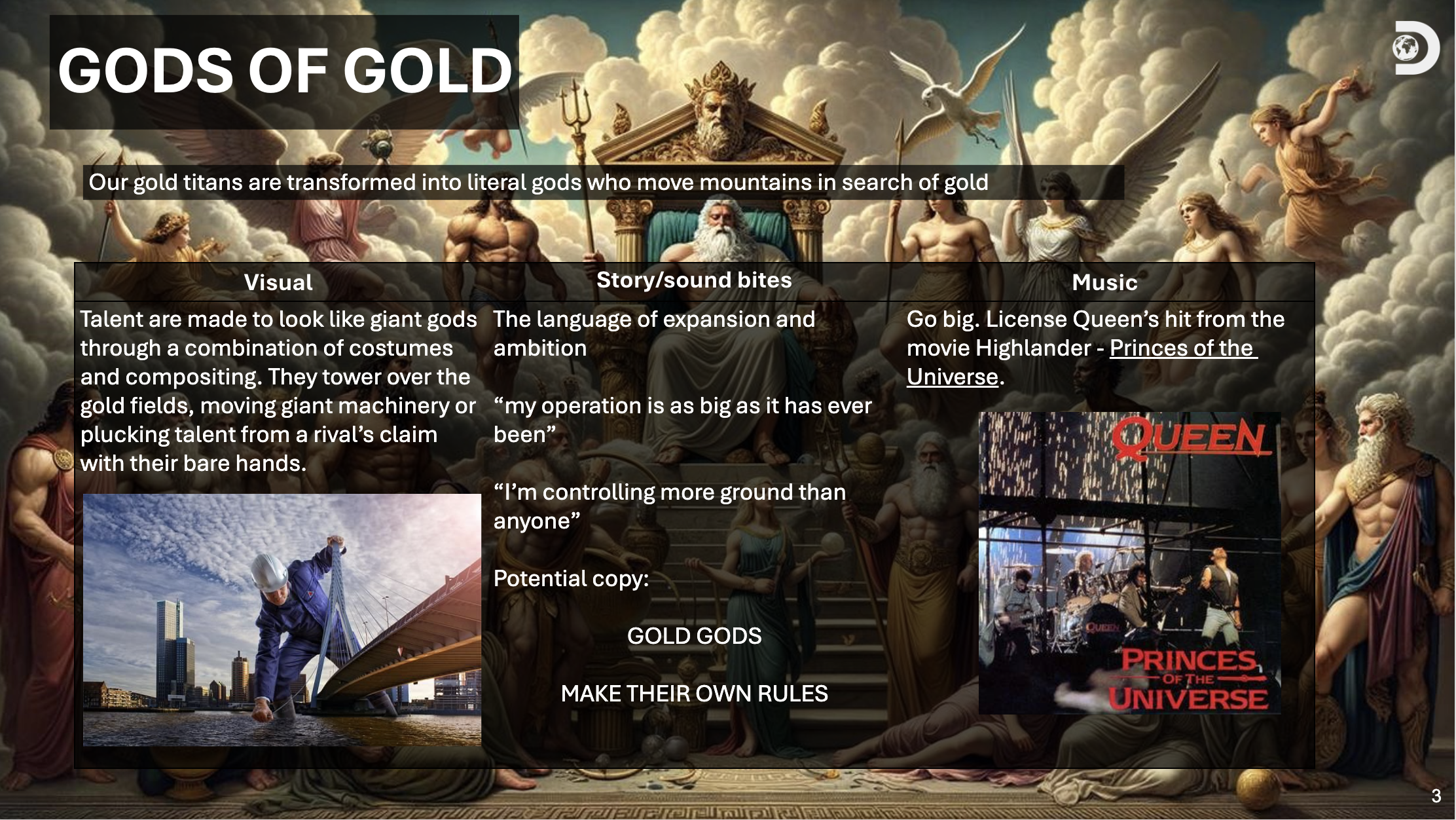
One of my more recent campaigns for Gold Rush started out like this.
I jotted down “Gods of Gold” and thought about what that would look like; what kind of copy and music would work with that, etc.
Step two: Pull The Thread
Once I get my foot in the door, I get a little bit of momentum. Or more accurately, gravity. I allow it to pull me deeper into an idea and don’t question whether or not that’s the right choice. That’s for someone else to decide later on. This is when stuff starts to pour out, and shockingly, some of it can be good. It can feel like I didn’t come up with it. Rather it came to me as if I’m channeling some divine source of marketing ideas. This is also when I start sending my ideas to editors or designers so they can be executed in rough form. From this exchange, a dialogue is opened and the process becomes collaborative.
Step three: Make Some Connections
Now I have the raw materials from which to build something, and the process becomes a bit like building with Legos. Each little brick is something from my brain dump in step two. I can sand down their rough edges and start to see how they fit together. Some can fit in surprising ways. At this point, I’m sharing what I have so far and starting to get some notes. In rare cases, these can be like meteorites that wipe out an idea altogether. But for the most part, they are doable, and the good news is, I am so familiar with my building blocks that I can think of many combinations that could work. Or perhaps I have the right combo but just need one more extra flourish. It depends on what the approvers think, and that’s why this is usually the longest step in the process. I need to get multiple busy people to agree on something subjective over email.
Step Four: Refine and Polish
Now I just need to make it shiny. Which sounds simple, but this part of the process can be frustrating for me. At this point, the idea is fully realized and executed. Once that happens, I can get anxious to move on, especially when everyone else seemingly wants to change one small aspect or another just so they can feel like they contributed. At least that’s what it seems like to someone being a little possessive. Usually they’re noticing something I didn’t, or considering an aspect that needs to be addressed. These notes can feel like asking for comic sans dialogue bubbles on the Sistine Chapel ceiling, but almost always, they’re fixing blind spots I am too close to see. I try not to take it personally (often a good life rule in general). Just when I think I’ve had enough, I get to see the final product in all its glory. And I get to see others react to it for the first time. These people weren’t around for the project’s uglier stages of development, and that is a fine payoff.
Final form of what started as “Gods of Gold”.
Step Five: Thanks for the Memories
Why is there another step? The project is done. Time to move on, right? Not quite. Now is the time for archiving and most importantly, saying thanks. An artistic piece may never be truly “done”, but in a business context, it sure needs to be. There are deadlines. And more ominously, beyond those are drop dead dates. Morbid alliteration aside, the last step in the creative process is appreciating what I have created by sharing and preserving it, as well as thanking everyone involved in making it. Thanking is easy. It feels good to pat each other on the back over email. Preservation is tedious but crucial. I need to upload and backup not just the final pieces but the key components used to make them. There have been many times where this practice has saved me from reinventing the wheel later. You never know.
That is my general process. No cats were harmed in the making of this blog post.